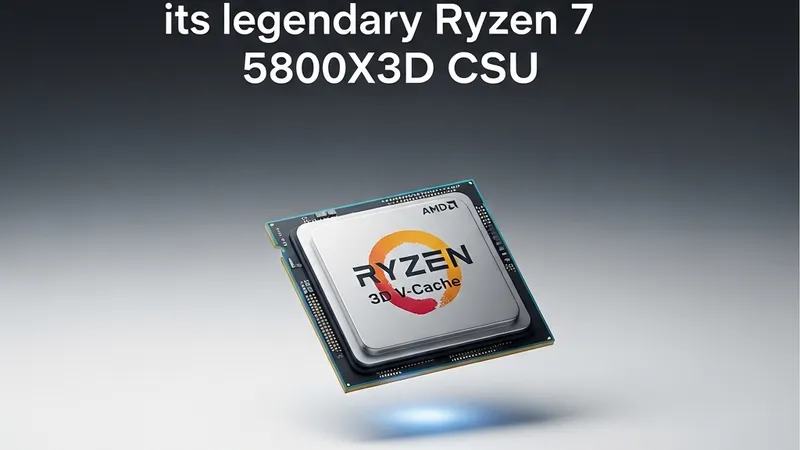
The next generation of AMD gaming CPUs is, in fact, the last generation of AMD gaming CPUs. With astronomical RAM prices gatekeeping gamers from upgrading their systems, the chipmaker has decided to re-release its former best-in-class AMD Ryzen 7 5800X3D for a price better than what you will find on the inflated eBay reseller market.
PC builders can grab one of AMD's Ryzen 7 5800X3D rehashes starting June 25, priced at $350. To put that price tag into perspective, it is $100 less than the card cost at its initial launch in 2022. By comparison, a current-gen Ryzen 7 9850X3D—the chipmaker's current flagship gaming CPU for AM5 motherboards—carries a suggested list price of $500. The 5800X3D first launched in 2022, just a few months before AM5 socket motherboards hit the scene.
Old is new again in other ways, too. AMD is preparing to launch the Ryzen 7 7700X3D, another eight-core, 16-thread previous-gen chip for the AM5 socket, priced at $330, on July 15. AMD has called this chip its "entry point" for the AM5 platform. You may wonder why a four-year-old chip costs more than a more recent Ryzen 7000-series CPU. You can blame memory prices and the abusive resale market. The price may not seem like a bargain unless you have hunted for one of these out-of-production chips yourself on reseller marketplaces like eBay, where listings in North America frequently demand $450 or more for this vintage CPU.
AMD is going a step further by helping PC buyers who cannot afford to upgrade their graphics cards. The company is bringing its $550 Radeon RX 9070 GRE to the U.S. market. That is essentially the same RX 9070 from 2025, but equipped with 12GB of VRAM instead of 8GB. It was previously exclusive to China, filling a strange niche inside AMD's current graphics card lineup, considering the Radeon RX 9060 XT has 16GB of VRAM, matching the leading RX 9070 XT.
The chipmaker has promised that the GRE card will be available starting June 1. AMD has historically been much better than Nvidia at keeping GPU costs relatively stable, though we do not expect the $550 price tag to remain for very long. In effect, PC builders may be looking at sidegrades rather than full upgrades in 2026. Gamers with older hardware are better off keeping their old DDR4 RAM sticks, which cost less on reseller marketplaces than upgrading to costly DDR5 setups.
Essentially, AMD is being forced to extend the lifespan of 10-year-old AM4 motherboards even further into the future. Although the chipmaker has promised to continue supporting the AM5 socket through 2029, by then, computing progress may already have stagnated on components made four, or even ten years ago.
[AgentUpdate Depth Analysis] AMD's strategy of resurrecting older architectures to bypass high upgrade costs highlights a critical bottleneck for the local AI Agent ecosystem: hardware accessibility. Running localized AI Agents and LLMs requires substantial memory bandwidth and VRAM. High DDR5 costs restrict mainstream adoption of local AI applications. By sustaining DDR4 compatibility and offering mid-range GPUs with 12GB VRAM like the RX 9070 GRE, AMD lowers the barrier to entry for developers and hobbyists wanting to run local LLMs. While this "sidegrading" path keeps costs low, it risks temporarily fragmenting the computing baseline. For the AI Agent ecosystem to truly scale, hardware manufacturers must balance cutting-edge memory bandwidth with mass-market affordability.