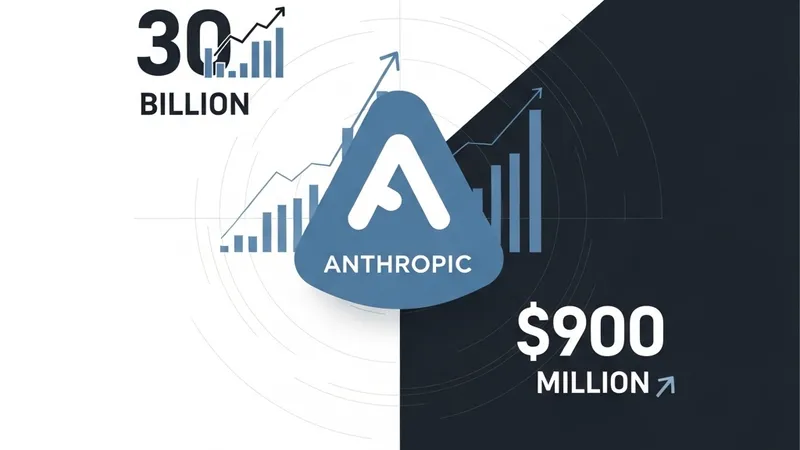
Anthropic, the generative AI pioneer, has reportedly agreed to the terms of a massive $30 billion funding deal that places the startup's valuation at a staggering $900 billion, according to the Financial Times. This historic transaction sets a brand-new benchmark for the global AI landscape, placing Anthropic's valuation in the same tier as established trillion-dollar tech giants.
Compared to rival OpenAI's recent $6.6 billion funding round at a $157 billion valuation, Anthropic's latest deal represents an exponential leap. This gargantuan valuation underscores the aggressive, long-term bets being made by tech giants like Amazon and Google, alongside sovereign wealth funds, on the future of Artificial General Intelligence (AGI).
Industry analysts point out that this astronomical valuation is heavily anchored in Anthropic's technical breakthroughs in the AI Agent ecosystem. The company's recent rollout of Claude 3.5 Sonnet, featuring the pioneering "Computer Use" capability, allows LLMs to interact directly with computer desktop interfaces. Furthermore, their open-sourced Model Context Protocol (MCP) aims to eliminate data silos, providing a standardized framework for developers to build powerful, unified Agent infrastructure.
[AgentUpdate Depth Analysis] Anthropic's jaw-dropping $900 billion valuation represents a strategic paradigm shift in capital allocation, moving from pure LLM pre-training to monopolizing the "Action-oriented Agent" infrastructure. While OpenAI prioritizes reasoning and multi-modality (as seen in the o1 series), Anthropic is positioning Claude as a foundational operating system for agents through Computer Use and the Model Context Protocol (MCP). By open-sourcing MCP, Anthropic is attempting to establish the "HTTP of the Agent era," creating a robust standard for connecting LLMs with external data sources and tools. This horizontal integration offers a much stronger moat than merely selling API tokens. If realized, this capital injection will rapidly accelerate the transition of AI Agents from isolated co-pilots to highly collaborative, enterprise-grade digital workforces, bringing us closer to the commercial singularity of agentic workflows.