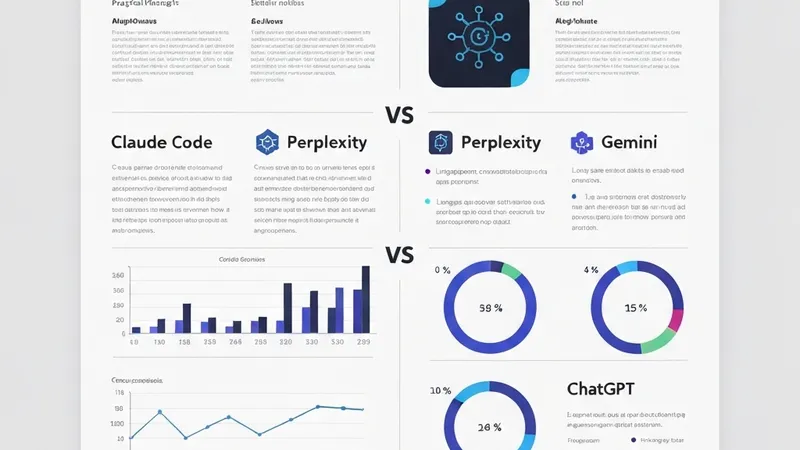
Which AI tool should you choose in 2026? With a plethora of options available, this article breaks down the practical, daily usage of the four dominant AI tools—Claude Code, Perplexity, Gemini, and ChatGPT—to help you find the perfect fit for your workflow.
Claude Code — My daily dev tool
Claude Code by Anthropic is by far the most used tool for development. What sets it apart is its direct integration into the terminal and editor. It can read and modify files, navigate an entire codebase, and comprehend the global context of a project, moving far beyond the limitation of copy-pasting code snippets into a chat window.
In practice, when an idea strikes, I ask Claude Code to structure the project and challenge my architectural choices. Crucially, this is a two-way street; I often disagree with its suggestions, which is precisely where the conversation becomes valuable. It is a powerful tool, not an oracle.
Perplexity — My reference for research
Perplexity is the go-to tool for reliable and verifiable answers. As a response engine that systematically cites its sources, it answers queries with direct excerpts and links to real web pages, effectively eliminating unsourced hallucinations.
However, its utility is mostly limited to the desktop. On smartphones, the user experience is frequently interrupted by aggressive prompts pushing the paid subscription version—understandable for monetization, but frustrating for quick searches.
Gemini — For those in the Google ecosystem
Gemini’s biggest strength is its native integration with Google Workspace, including Gmail, Docs, Drive, Sheets, and Google Search. For Google Pixel users, the ecosystem integration is incredibly seamless, allowing quick document analysis and summarization without leaving the interface.
That said, Gemini’s response quality can occasionally falter, requiring users to remain cautious. Furthermore, if data privacy is your top priority, you should think twice before feeding sensitive personal documents into its ecosystem.
ChatGPT — The natural entry point
OpenAI’s ChatGPT remains the most versatile and well-known AI. From writing and coding to analysis, translation, and creative tasks, it handles almost everything competently. The free tier (GPT-4o mini) remains highly capable and is the easiest starting point for beginners.
However, ethical concerns, particularly OpenAI’s partnership with the Pentagon, have led to significant user boycotts. Beyond ethics, users must also remain aware that ChatGPT, by default, uses conversational data to train its models, which requires manual opt-out in the settings.
[AgentUpdate Depth Analysis] By 2026, the AI landscape has shifted from passive chat interfaces to deeply integrated, agentic workflows. Claude Code’s developer dominance highlights the success of terminal-native agents powered by standard protocols like MCP (Model Context Protocol). It transitions AI from a conversational oracle to a proactive collaborator capable of executing real-world tasks within the codebase. Perplexity’s RAG-driven approach demonstrates the evolution of search into synthesized, actionable knowledge agents. Meanwhile, the future of the AI Agent ecosystem hinges on interoperability and privacy. Platforms that offer open integrations and respect local context will outpace walled gardens. For tech professionals, the ultimate metric is no longer raw model parameters, but the agent's capability to orchestrate complex, multi-step actions across various environments securely.