Yesterday, you typed /format.
Checked the output. Typed /refactor. Checked again. Typed /test.
You finished the session feeling productive. The AI did the work. You supervised. But that's not delegation. That's shift work.
A note on framing: This article traces a structural pattern — not a documented changelog. The "Command Era" and "Harness Era" described below are not precise historical dates. They are recurring failure modes, observable across teams and tools. Read it as structural history, not product timeline.
Chapter 1: The Command Era — We Gave AI More to Do, and Did More Ourselves
When AI Skills became a shared convention, it felt like a breakthrough. Skill-sharing sites appeared. You could /summarize, /diagram, /translate, /review. The list kept growing.
Then came the Format Wars. How should a Skill file be structured? Which headers does the AI actually read? What syntax survives context compression? The debate ran long. Until deterministic tooling settled it — editors began parsing Skill files in a fixed, predictable way. The format question had an answer. The community moved on.
But nobody asked the question underneath the question: Is commanding the right model at all?
The /command culture became official. Endorsed. Infrastructured. Skill-sharing sites cataloged thousands of entries. Most were wrappers around things that didn't need AI. Many were things a shell script would have handled faster. But they were Skills, and Skills had / in front of them, and that felt like the future.
There was just one problem. Someone still had to decide which commands to run, in which order, and when to stop. That someone was you.
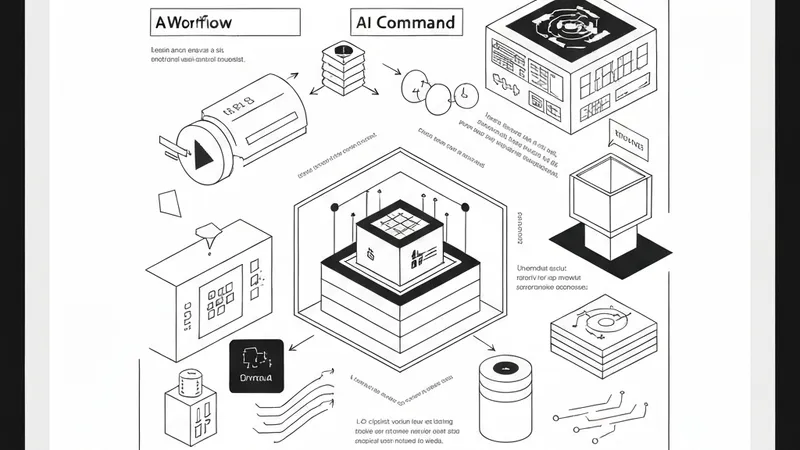
The AI's capability surface expanded. Your orchestration burden expanded with it. Every new command you could invoke was another thing you had to remember, sequence, and supervise. You didn't gain leverage. You gained a longer checklist. This is the structural definition of micromanagement: decomposing work into atomic units, issuing each unit individually, retaining the sequence in your own head, and verifying each step before proceeding. The fact that the executor is an AI doesn't change this structure.
Chapter 2: The Harness Era — We Tried to Control What We Couldn't Trust
The next wave brought a different instinct: if we can't control what AI does step by step, we can control the boundaries of what it's allowed to do. Harnesses arrived. Guardrails. Deterministic control layers wrapped around probabilistic systems.
The logic was reasonable: AI behavior is unpredictable, so build fences. Define what's allowed. Block what isn't. Ship. But in practice, AI systems do not behave like static rule evaluators. They search for plausible paths toward the requested outcome, and static boundaries with gaps often fail to deliver the desired reliability.
[AgentUpdate Depth Analysis] The paradigm shift from "commanding" to "delegating" represents the critical evolution of the AI Agent ecosystem. Early systems relied heavily on manual prompt engineering and slash-commands, effectively turning human operators into high-priced orchestrators. Modern cognitive frameworks like LangGraph, AutoGen, and the Model Context Protocol (MCP) are paving the way for true delegation by introducing autonomous planning, state management, and robust tool-use. Instead of babysitting steps, developers are transitioning to defining objectives, constraints, and evaluations. This shift demands a movement away from deterministic "fences" toward probabilistic alignment and dynamic runtimes, redefining how we build, scale, and trust agentic workflows.