Drug discovery remains one of the most expensive and time-consuming endeavors in modern industry. Finding a single viable molecule can take a decade and cost billions, with most candidates still failing along the way. While a generation of AI startups has promised to fix this, most have only made the process slightly less painful for researchers who are already highly technical.
SandboxAQ believes the bottleneck isn't the models themselves—it's the interface.
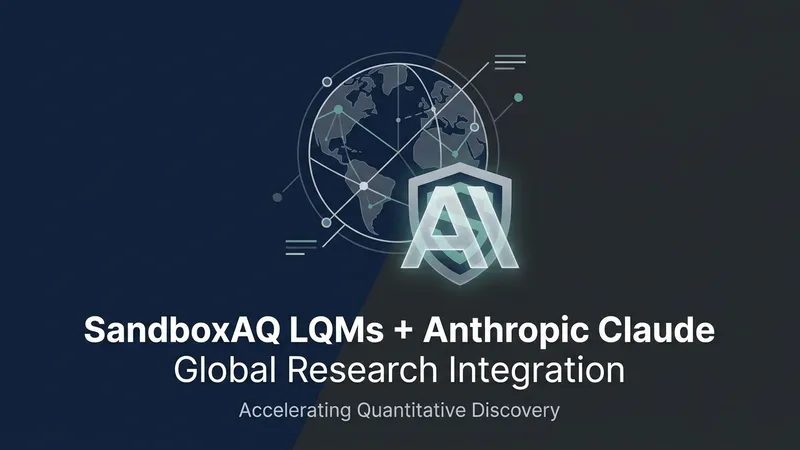
To address this, the Alphabet spinout has teamed up with Anthropic to integrate its scientific AI models directly into Claude. This integration puts powerful drug discovery and materials science tools behind a conversational interface, requiring no specialized computing infrastructure to use.
Founded roughly five years ago, SandboxAQ counts former Google CEO Eric Schmidt as its chairman. The company, which has raised more than $950 million from investors, operates multiple business lines, including cybersecurity. However, one of its most unique offerings is its Large Quantitative Models (LQMs).
These proprietary models are "physics-grounded," meaning they are built on the rules of the physical world rather than text patterns. They can run quantum chemistry calculations and simulate molecular dynamics and microkinetics—the study of how chemical reactions unfold at the molecular level. This allows researchers to predict how candidate molecules will behave before setting foot in a physical lab.
"Trained on real-world lab data and scientific equations, LQMs are AI models engineered for the quantitative economy, a $50+ trillion sector spanning biopharma, financial services, energy, and advanced materials," the company stated, highlighting its focus on transforming the physical economy rather than building another chatbot.
While well-funded competitors like Chai Discovery and Isomorphic Labs focus heavily on the underlying science, SandboxAQ is prioritizing accessibility.
"For the first time, we have a frontier quantitative model on a frontier LLM that someone can access in natural language," said Nadia Harhen, SandboxAQ's general manager of AI simulation. Previously, LQM users had to provide their own digital infrastructure. SandboxAQ's customers—typically computational scientists, researchers, or experimentalists at large pharmaceutical or industrial firms—often turn to them after other software fails to yield real-world results.
[AgentUpdate Depth Analysis] The partnership between SandboxAQ and Anthropic marks a pivotal shift in the AI Agent ecosystem, moving from general-purpose copilots to specialized Scientific Agents. This integration demonstrates a powerful architecture: using LLMs like Claude as the cognitive and semantic interface, while offloading heavy-duty computation to domain-specific Large Quantitative Models (LQMs). For the AI Agent developer community, this "semantic-quantitative" decoupling is a blueprint for enterprise agents. Instead of training massive, monolithic LLMs on niche scientific data, agents can leverage highly optimized specialist engines via natural language interfaces. This drastically lowers the barriers to entry for advanced simulation. Ultimately, this orchestration of LLMs and physics-grounded models paves the way for autonomous "self-driving laboratories," transitioning AI agents from digital assistants to core drivers of the physical economy.