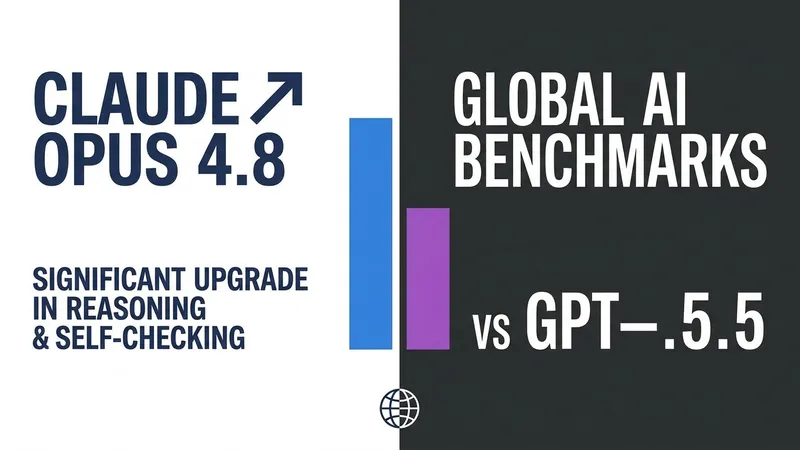
As artificial intelligence continues its rapid evolution, Anthropic has unveiled Claude Opus 4.8. Although framed as a modest upgrade, early users report highly meaningful improvements, highlighting better judgment, reduced hallucination, stronger self-checking mechanisms, and an increased willingness to push back against user errors. This release focuses heavily on benchmark comparisons with GPT-5.5, Claude Code’s new dynamic workflows, and how commands like /goal are unlocking unprecedented efficiency in AI-assisted development.
In performance evaluations, Claude Opus 4.8 shines in cognitive reflection. Unlike previous versions and competitors like GPT-5.5, Opus 4.8 does not blindly agree with incorrect premises; instead, it actively detects logical inconsistencies and flags them. This willingness to push back is crucial for deploying reliable enterprise-grade AI. Furthermore, in coding environments, Claude Code leverages this enhanced capability to drive highly adaptive workflows. Developers are beginning to realize that the "model harness"—the scaffolding, routing, and guardrail layers built around the core LLM—is becoming just as critical to real-world performance as the raw model weights themselves.
Beyond these model updates, several major industry developments are reshaping the tech landscape: Elite law firm Kirkland & Ellis is making a massive bet on internal AI deployment; OpenAI has quietly updated GPT-5.5 Instant; Cognition AI is reportedly raising funds at an astonishing $26 billion valuation; Meta is evaluating an AI cloud offering; and Microsoft is preparing to launch a new suite of models. The competitive race across infrastructure and applications shows no signs of slowing down.
[AgentUpdate Depth Analysis] The launch of Claude Opus 4.8 and the emergence of goal-driven developer commands like /goal signal a pivotal shift in the AI Agent ecosystem: transitioning from strict instruction-following prompts to autonomous, goal-oriented execution. In this new paradigm, users no longer need to micromanage every step of a workflow. Instead, they define the desired end state, and the agent autonomously plans, invokes tools, monitors state changes, and self-corrects. Opus 4.8's unique ability to "push back" addresses a critical safety and efficiency bottleneck in agentic systems, ensuring that agents do not execute hallucinated or harmful actions blindly. Ultimately, this highlights that the future of agentic engineering lies in the synergy of advanced core models and highly sophisticated "harnesses" (or cognitive scaffolding) that orchestrate tool-calling, state management, and continuous reflection.